
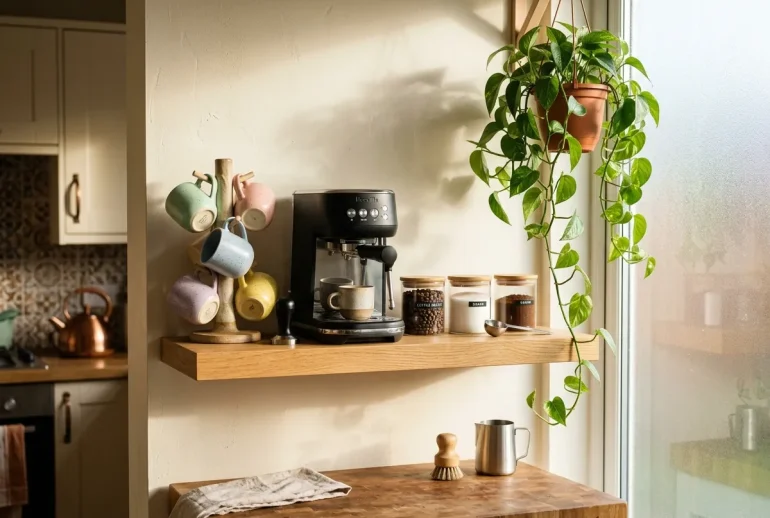
You do not need a sprawling kitchen or a big renovation budget to enjoy a beautiful coffee bar at home. Whether you are working with a tiny countertop, a forgotten corner, or a narrow hallway niche, there is a setup that fits your space. This guide covers coffee bar ideas for small spaces — from smart indoor builds to charming outdoor stations — so you can wake up to a morning routine that feels personal, practical, and worth savoring. Every idea here is approachable, affordable, and easy to pull off on your own.
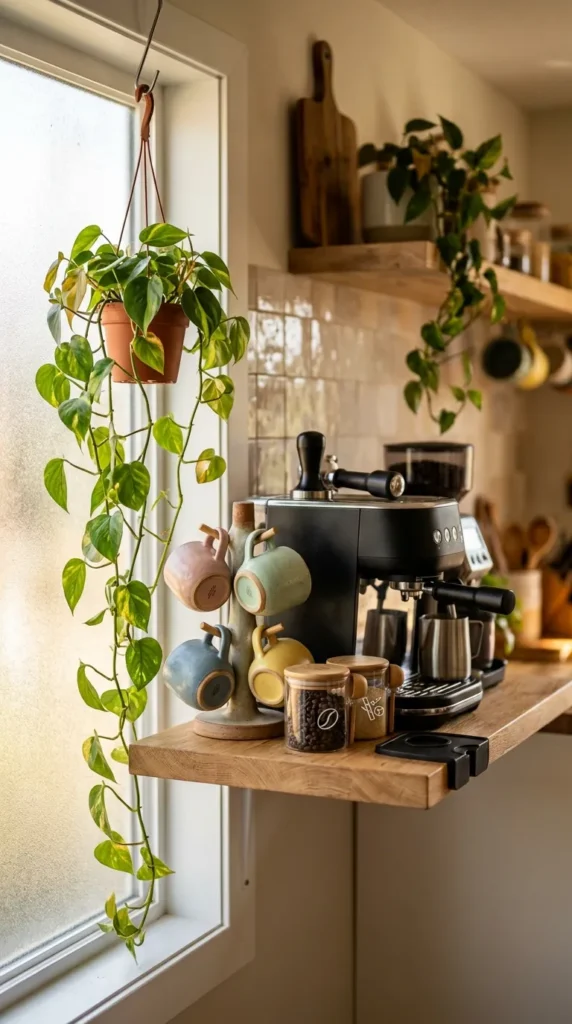
Read More Article: https://glamorabeauty.blog/25-small-kitchen-ideas-to-maximize-space-storage-and-style/
1. Use the Corner Countertop Wisely
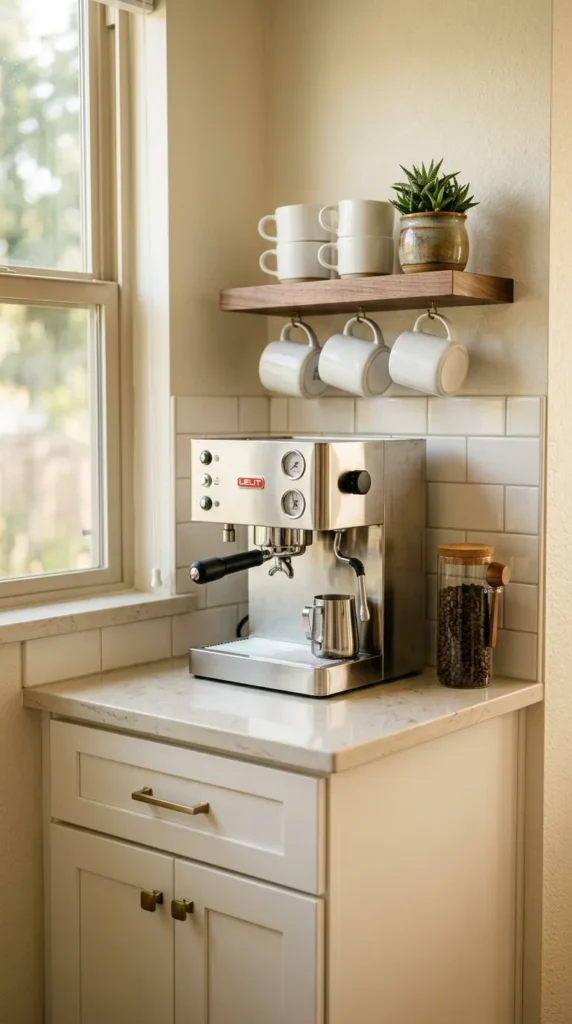
Corner countertops are some of the most underused spots in a small kitchen. They sit at an angle and often collect clutter, but they are actually a perfect spot for a compact coffee station.
Start by clearing everything off the corner. Keep only what belongs to your coffee routine.
Place your machine directly in the corner — it naturally fits snugly. Then mount a single floating shelf above it at eye level. This shelf holds your mugs, a small canister for beans, and maybe a tiny plant.
Keep it to three things on the shelf. Overcrowding is the enemy of small-space design.
If your countertop is shallow, look for a slim coffee maker — many quality drip machines are under 7 inches wide. Brands like Bonavita and OXO make narrow, high-performing models under $60.
Use adhesive hooks on the side of the cabinet above to hang measuring spoons. That frees up even more surface space.
The key rule: everything on that counter should serve your coffee ritual. If it doesn’t belong, move it somewhere else. This one rule alone makes the space feel intentional instead of cramped.
2. Mount a Peg Rack for Mugs
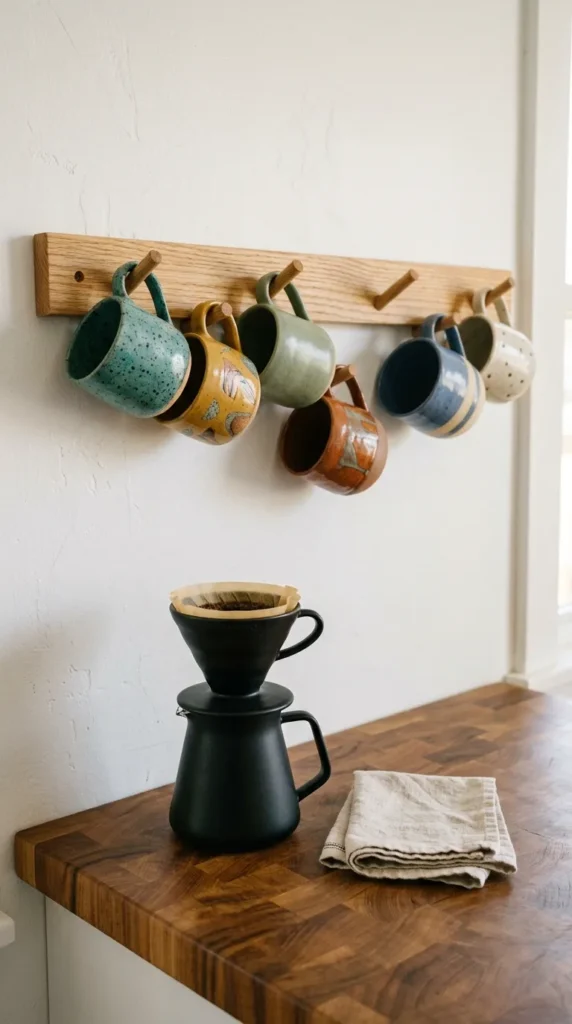
A peg rack is one of the smartest small coffee bar ideas you can try. It costs almost nothing, takes ten minutes to install, and completely changes how your space feels.
Instead of hiding mugs inside a cabinet — where you have to dig for your favorite — a peg rack puts them on full display. It turns everyday mugs into part of your kitchen decor.
You can find pre-made wooden peg racks at IKEA, Target, or on Etsy for under $30. Or make your own with a piece of 1×4 lumber, a few wooden dowels, and a drill.
Mount it on the wall directly above your coffee machine. Keep the spacing tight — about 4 inches between pegs — so mugs hang close together and look intentional.
This works especially well in small kitchens because it moves storage off the counter and onto the wall. That simple shift frees up precious work surface without taking anything away from function.
Mix and match mugs in similar colors for a collected-but-cohesive look. Or go bold with a set of matching ceramic mugs in one color. Either way, the rack becomes a quiet focal point — one that actually makes mornings more enjoyable.
3. Install a Slim Pull-Out Drawer Cabinet
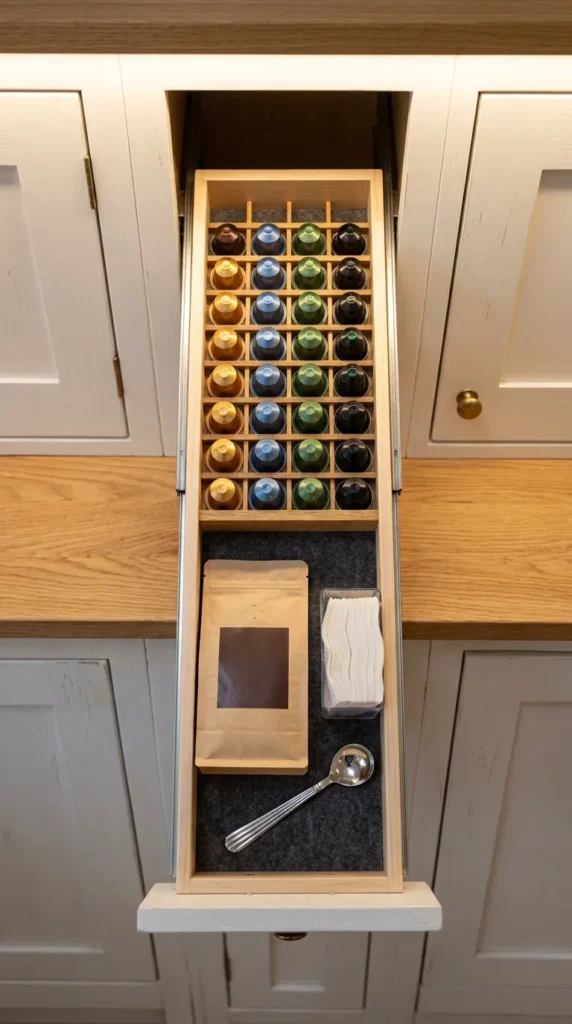
Most kitchens have at least one narrow gap — between the fridge and the counter, or between two lower cabinets. That gap is your hidden storage goldmine.
A slim pull-out drawer — sometimes called a filler pull-out — fits into spaces as narrow as 4 to 6 inches. You can find ready-to-install versions at IKEA (the SEKTION line) or on Amazon for $40–$80.
Use it to store everything that normally clutters your coffee station: pods, paper filters, small measuring spoons, stirrers, sugar packets, and extra beans.
Nothing lives on the counter that can live in the drawer. That is the organizing principle that makes small coffee bars feel clean.
If a pull-out cabinet is too much of a project, a much simpler option is a narrow bamboo drawer organizer placed inside an existing cabinet. It achieves almost the same result for under $15.
Label small containers inside with a label maker or chalk labels. It keeps things findable and looks intentional.
This kind of hidden storage is the secret behind coffee bars that look minimal on the surface. The machine and mugs are front and center — everything else disappears into the cabinet. Clean counter, calm morning.
Read More Article: https://glamorabeauty.blog/12-gorgeous-outdoor-party-setup-ideas-for-instagram-worthy-events/
4. Float a Shelf Over the Fridge
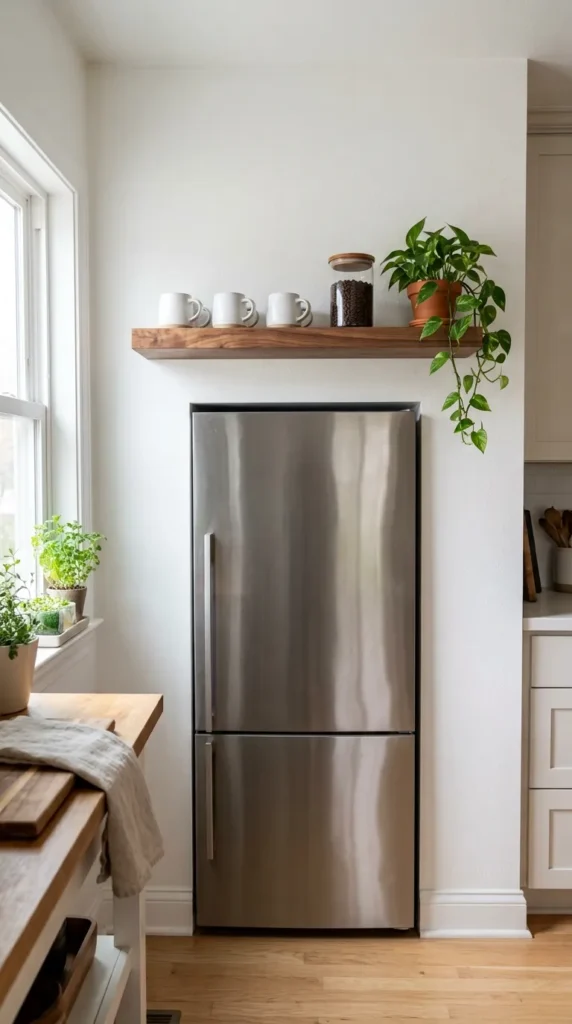
The wall above your fridge is almost always wasted space. In a small kitchen, wasted space is a problem you can solve in an afternoon.
Mount a single floating shelf above the fridge — about 12 to 15 inches above the top — and suddenly you have a dedicated spot for your coffee essentials.
This works best for items you do not need every single day: backup bags of beans, extra filters, a travel mug you grab on weekdays, or your collection of specialty coffee syrups.
Use a bracket-style floating shelf that can hold 20–30 lbs. You can find solid ones at Home Depot or IKEA for under $25. Make sure to hit a stud when you mount it — that wall gets bumped regularly.
Style tip: Keep the shelf to three or four items max. A clear glass canister of beans, two mugs, and a small plant. That’s it. Restraint is what makes it look designed rather than cluttered.
If your fridge is at the end of a run of cabinets, this shelf can visually extend the cabinetry line — making the kitchen look longer and more cohesive.
It is a small move with a surprisingly big impact on how organized your kitchen feels every morning.
5. Try a Fold-Down Wall Bracket Station
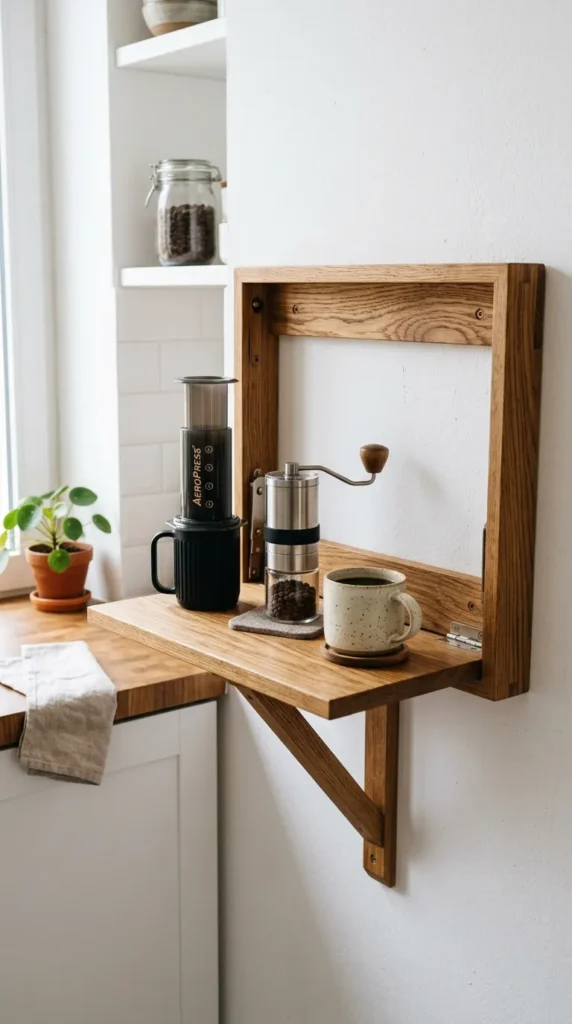
If you live in a studio apartment or a rental with almost zero counter space, a fold-down wall bracket is the most space-efficient coffee bar idea on this list.
When you need it, flip it down. Use it. Flip it back up. The wall is clear again.
You can find fold-down wall shelves at IKEA (the NORBERG is a classic) for around $30. They come in white or wood tones and mount to the wall with just four screws. You only need to hit one stud.
On the fold-down surface, keep only your daily driver: an Aeropress, a small hand grinder, and one mug. These are compact tools that make excellent coffee without requiring a machine with a footprint.
Store beans and everything else in a small basket on a nearby shelf or inside a cabinet. Bring them out when you brew, put them away after.
This setup is ideal for renters who want a real coffee ritual without permanently altering the space. No drilling into countertops. No bulky machines. Just a clean wall and a well-designed routine.
It is proof that good coffee does not require a lot of room — just the right system.
6. Match Your Coffee Station to Kitchen Cabinetry
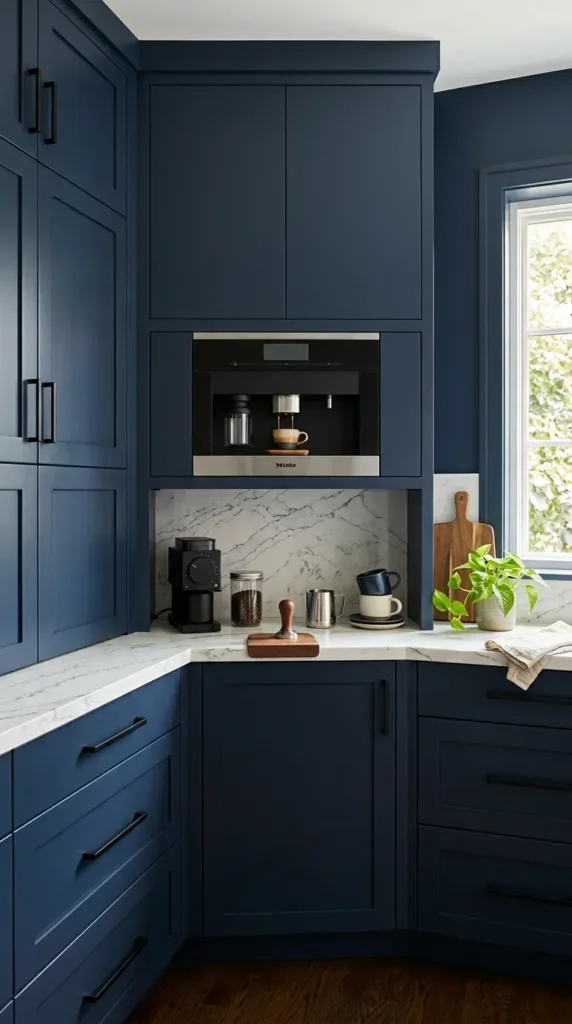
The cleanest-looking small kitchen coffee bar is the one that does not look like an add-on.
When your coffee station matches the existing cabinetry — same color, same hardware, same countertop — it looks like it was always part of the plan. This is called visual continuity, and it makes small kitchens feel bigger.
If you are renting or on a tight budget, you do not need to renovate to achieve this. Instead, paint a small rolling cart or open shelf the same color as your cabinets. Use the same style of hardware: brushed brass pulls, matte black knobs, or whatever you already have.
Color-match the accessories too. If your kitchen has white cabinets and black hardware, keep your coffee machine black and your mugs white. Swap out any stray colors.
For homeowners doing a refresh, consider adding a small built-in cabinet at the end of your counter run — just wide enough for the machine and one shelf above it. Cabinet makers can often add a single 12-inch unit for a few hundred dollars, far less than a full renovation.
The goal is to make the coffee station feel like part of the kitchen — not an afterthought sitting on the counter.
7. Tuck Appliances Inside a Cabinet with Pocket Doors
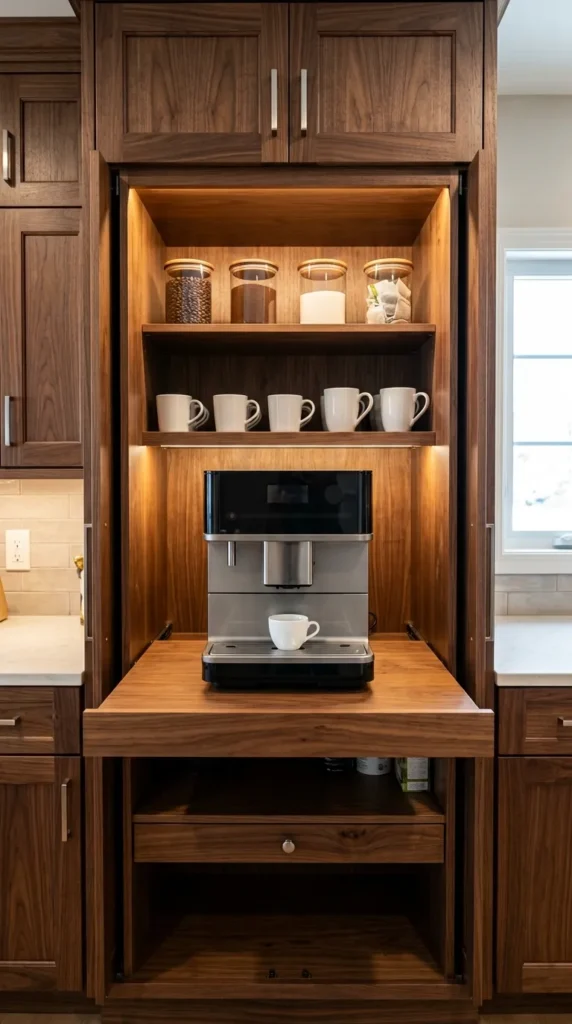
The cleanest countertop is an empty countertop. If your coffee machine is always sitting out but you wish it were not, pocket doors are the answer.
A cabinet with pocket doors slides open when you need it and disappears back into the wall when you do not. The machine lives inside. The counter stays clear.
This works best if you are doing even a minor kitchen update. Adding pocket doors to an existing cabinet is a weekend project — the hardware kits cost $20–$40 at home improvement stores, and most standard upper cabinets can be retrofitted.
Inside the cabinet, install a pull-out shelf so the machine slides forward when you use it. This keeps you from reaching deep into the cabinet every morning.
If a full cabinet modification is too much, a simpler version is a tall appliance garage — a small cabinet on the counter with a roll-up or tambour door. These are available online for $80–$150 and sit neatly on the counter like a mini cabinet.
The machine is always ready. The counter always looks clear. That combination is exactly what makes small coffee bars feel intentional rather than chaotic.
8. Carve Out a Butler’s Pantry Coffee Nook
A butler’s pantry does not need to be large or fancy to work well. Even a 4-foot pass-through pantry can house a proper coffee station if you plan it right.
The best addition you can make to a pantry coffee nook is a small prep sink. When your coffee setup has its own water source, you are not constantly crossing the kitchen to fill the machine. It makes the morning routine faster and more enjoyable.
Even a small bar sink — 9 to 12 inches wide — is enough. Pair it with a single cold-water line and a small under-counter space for the machine. If plumbing is off the table, a counter-top water dispenser works almost as well.
Above the prep area, open shelves keep mugs and beans accessible without doors to open and close. Keep three to four items per shelf level — mugs, canisters, a small plant.
Use a backsplash to define the space. Subway tile, peel-and-stick tile, or even painted wood beadboard all work well and cost very little.
This nook does not need to be big to feel complete. A sink, a machine, a shelf, and a few mugs — that is a proper coffee bar, regardless of the square footage.
9. Install a Rail System for Hanging Accessories
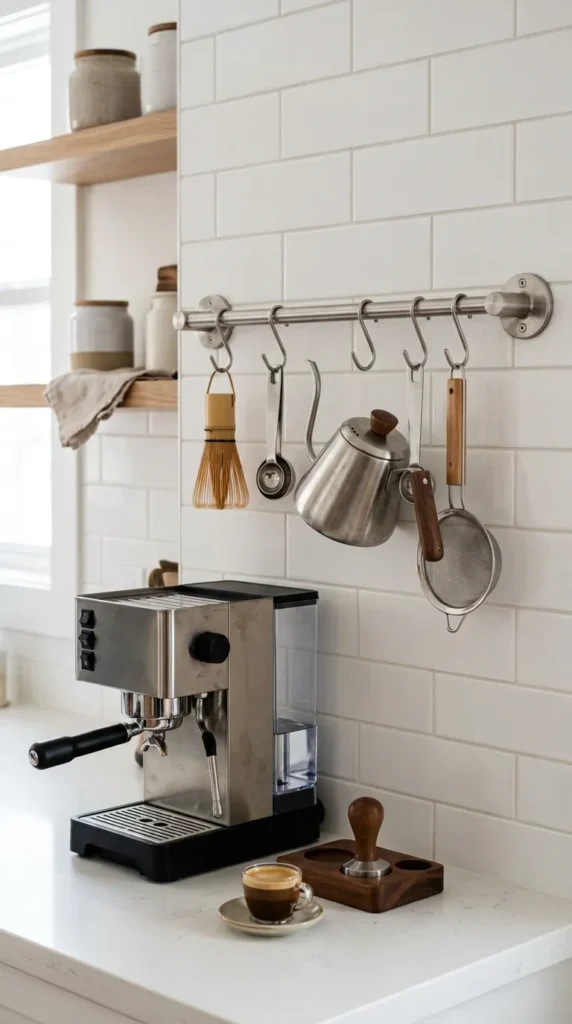
Countertop space is at a premium in small kitchens. A wall-mounted rail system solves the clutter problem without taking up a single inch of that precious surface.
A rail is a horizontal bar — usually stainless steel or brass — that mounts on the wall or backsplash. You hang small cups, hooks, and containers from it using S-hooks or magnetic clips.
What can you hang? Measuring spoons, a matcha whisk, a small pour-over kettle, a jar of sugar packets, a hand towel. Anything that used to live on the counter can now live on the rail.
IKEA’s GRUNDTAL rail is a great starting point — around $15, mounts easily, and works in kitchens of any style. For something more elevated, Rejuvenation and Schoolhouse sell solid brass versions for $30–$50.
Mount the rail directly behind your coffee machine on the backsplash. Keep the height accessible — between countertop level and eye level so nothing is out of reach.
This system works especially well in rental apartments because it mounts with adhesive strips (like 3M Command strips) if you cannot drill into the backsplash.
A rail system turns the wall behind your machine into active storage. It is one of the simplest, most affordable ways to make a small coffee station feel professionally organized.
10. Build a Cane Webbing Shelf Above the Counter
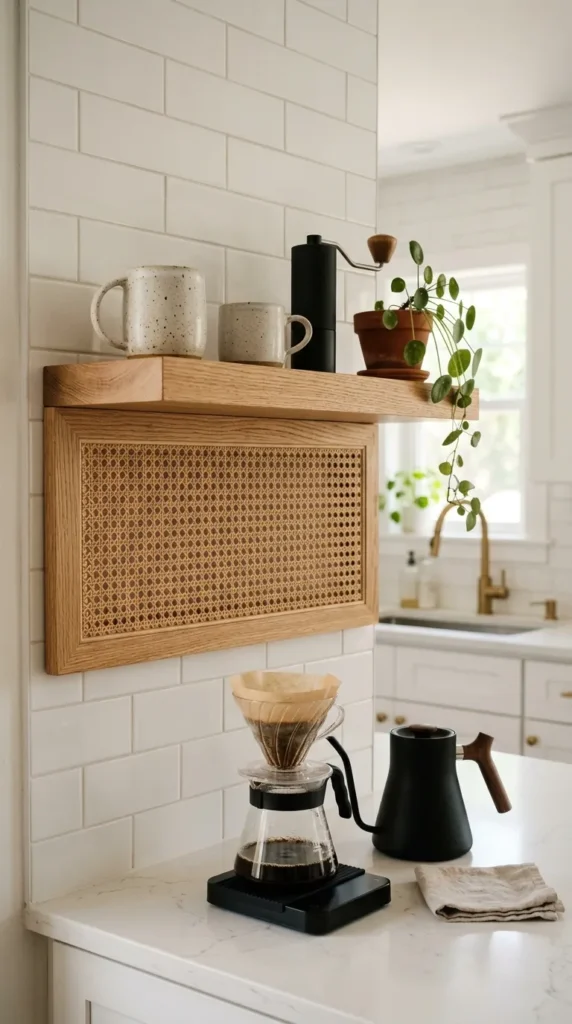
Cane webbing is everywhere in interior design right now — and for good reason. It adds warmth, texture, and an organic quality to any space without overwhelming it.
A floating shelf with a cane webbing panel underneath — either as a decorative back panel or a cabinet face — brings that same softness to your small coffee bar.
You can buy pre-made cane webbing shelves on Etsy or at furniture stores for $60–$120. Or build your own: get a wood plank, add hairpin legs or wall brackets, and staple a piece of cane webbing from a craft store to the underside or back.
On the shelf, keep it simple. A grinder, two mugs, and one small plant. The cane webbing is already doing design work — the items on the shelf just need to stay out of its way.
This works especially well in modern or Scandinavian kitchens where everything else is flat and minimal. The texture of the cane adds the visual interest that the rest of the space does not have.
It also works in boho and coastal kitchens, where natural materials are part of the language of the whole room.
One shelf, one texture, one purpose. That is all it takes to make a corner of your kitchen feel considered and complete.
11. Transform a Hallway Niche Into a Coffee Station
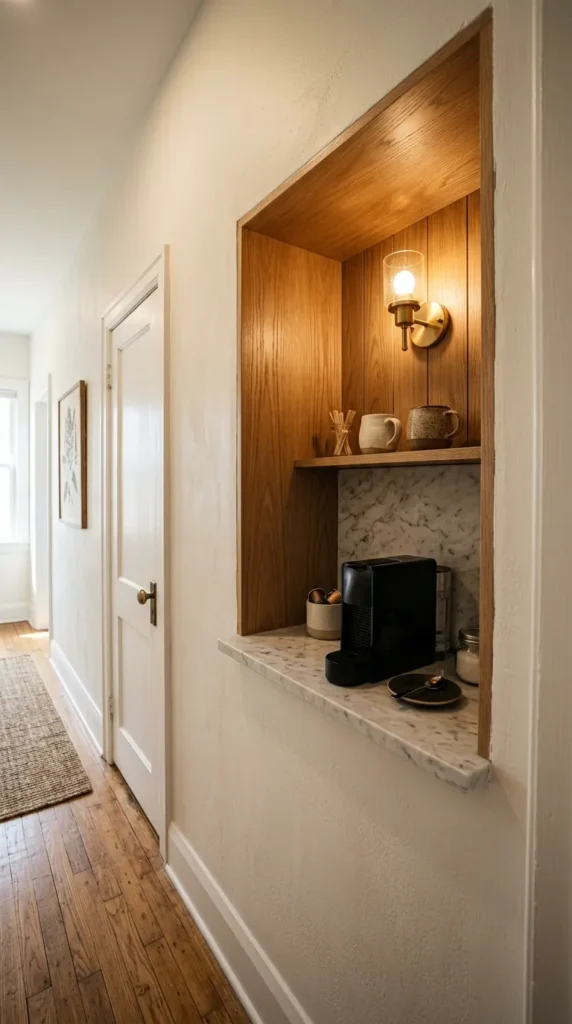
Not every coffee bar lives in the kitchen. A hallway niche is one of the most charming small-space solutions — and most people walk right past the opportunity every day.
That recessed space in your hallway? It is already the perfect size for a compact coffee station.
Start by adding a small shelf or slab of marble-look countertop inside the niche. This is your work surface. Mount it at a comfortable height — around 34 to 36 inches from the floor.
A single-serve coffee maker like a Nespresso Vertuo or a Keurig fits perfectly in a niche without overwhelming it. Run a power strip inside so the cord stays hidden.
Line the back of the niche with wood paneling or shiplap for dimension. This is what makes the niche look intentional rather than accidental. Peel-and-stick wood panels from Amazon cost around $30 and go up in an hour.
Add a small wall sconce above for mood lighting. This one addition transforms a functional nook into a space that actually feels good to use in the morning.
No counter space used. No floor space lost. Just a beautiful little station that greets you every morning as you walk toward the kitchen.
12. Convert an Arched Alcove With Tile and Open Shelves
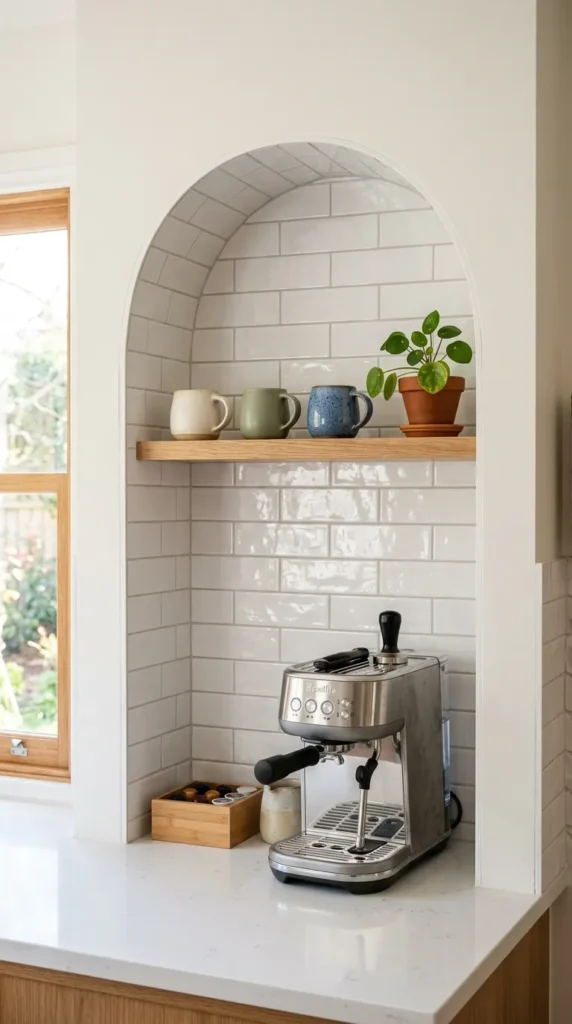
Arched alcoves are architectural gifts. If you have one in your kitchen or dining room, turning it into a coffee station is one of the best uses of that space.
The arch gives the station a built-in frame — so even a basic setup looks finished and intentional from the moment you add the first shelf.
Line the inside of the arch with glossy subway tile. This adds depth, is easy to clean, and makes the space feel polished. A box of 3×6 subway tiles at a home improvement store costs around $20–$30.
Add a small countertop slab at a comfortable height. Prefabricated marble-look quartz remnants are often available at stone yards for $50–$100 and can be cut to fit any niche.
Mount a single narrow shelf in the upper half of the arch for mugs. Keep it to three items — mugs, a plant, or a small jar.
The arch does a lot of the visual work for you. Your job is restraint — keep the inside clean, limit the accessories, and let the shape speak.
This is one of those ideas that photographs beautifully and costs very little if you are willing to do the tile work yourself on a weekend.
13. Use the Space Under the Stairs
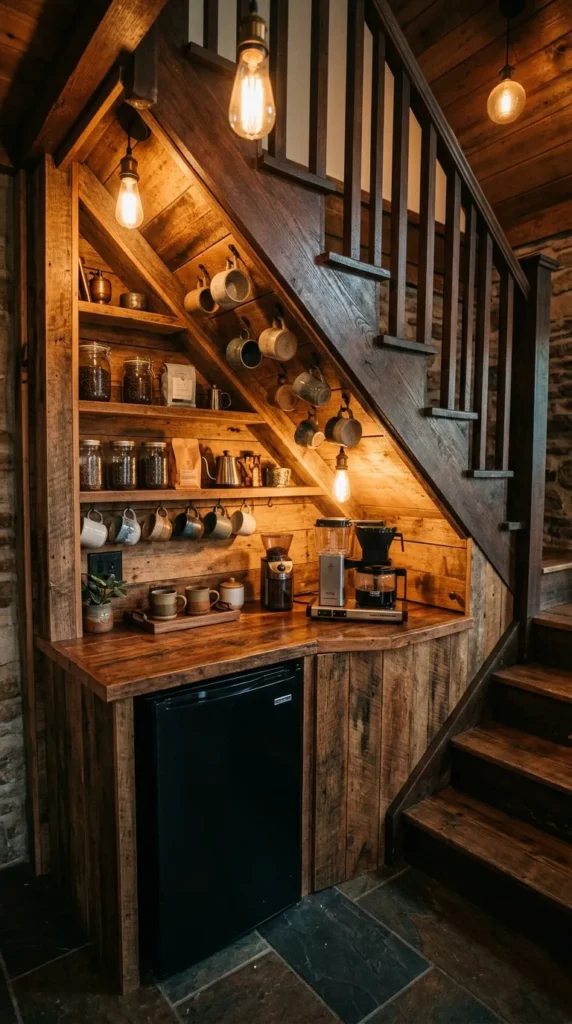
The area under a staircase is one of the most overlooked spots in any home. It is usually used for shoe storage or left empty. But it is one of the best spaces for a coffee bar — especially in open-concept homes where there is no dedicated kitchen nook.
The triangular shape under stairs naturally fits a compact setup. The tallest part of the opening can accommodate a full-height shelving unit or a small refrigerator for milk and creamers. The shorter part near the floor works for a cabinet.
Build a simple wood countertop across the widest section — that becomes your prep and machine surface. Use the wall above for open shelves to hold mugs, beans, and small accessories.
Hang hooks from the underside of the lowest step for your everyday mugs. It is a clever detail that feels custom without costing much.
Add a small LED strip light under the lowest shelf or stair to light the space. Under-stair areas are naturally dim, and good lighting makes all the difference between a functional nook and one that feels forgotten.
Designer Marnie Ousler, who built a version of this for a client, put it simply: “Coffee bars aren’t just for the kitchen.” This idea proves exactly that.
14. Tuck a Station Into a Recessed Wall Between Studs
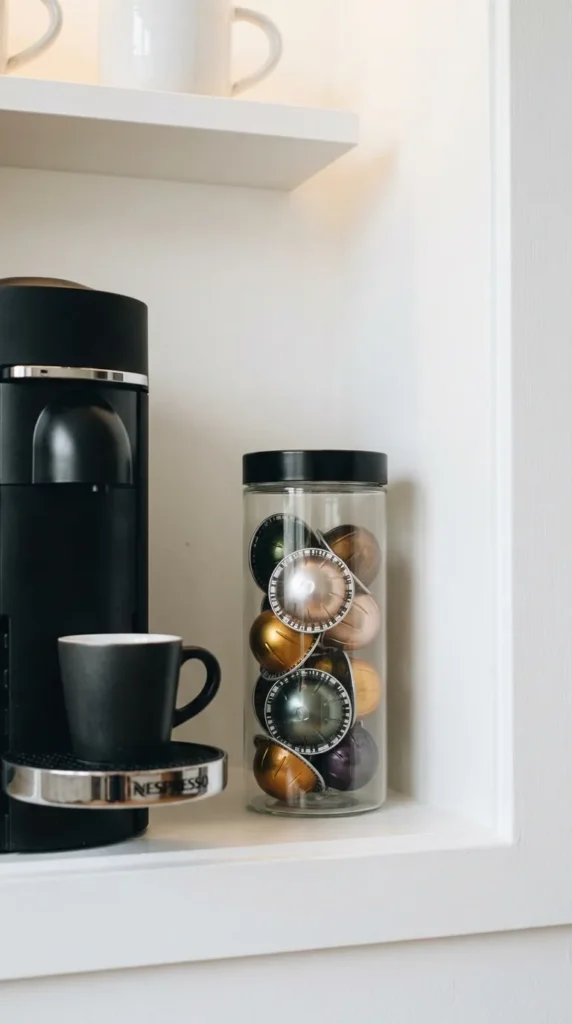
Between almost every pair of studs in your wall is 3.5 inches of empty space. Most people never think about it. But a recessed wall niche built into that space is a brilliant small-space trick.
A standard stud-bay niche is roughly 14 inches wide and as tall as you want to make it — typically 24 to 36 inches. That is enough room for a Nespresso machine, a small shelf above it for a mug or two, and a power outlet inside.
Hire an electrician to add an outlet inside the niche — this is the most important step. It keeps the cord completely hidden and makes the whole setup look built-in.
This only works on non-load-bearing interior walls, so check with a contractor before cutting. In most homes, interior partition walls are fair game.
Finish the inside of the niche with the same paint or tile as the surrounding wall so it looks intentional. Add a thin wood shelf at the top for mugs.
The result: a coffee station that takes zero counter space and zero floor space. The machine is literally inside the wall. For small apartments and tiny homes, this is as close to magic as home design gets.
15. Stock a Two-Tier Bar Cart for Coffee
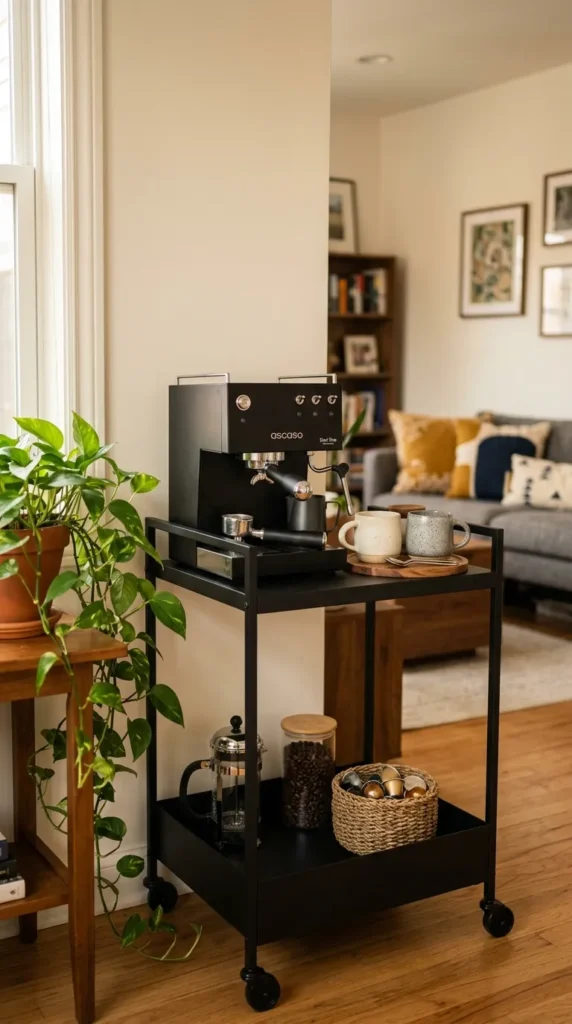
A rolling bar cart is the most renter-friendly coffee bar idea on this list. No drilling. No permanent changes. No tools required beyond a hex wrench to assemble.
Choose a two-tier cart — the top surface for your machine and mugs, the lower shelf for beans, syrups, a French press, and backup supplies. A solid bar cart costs anywhere from $60 at Target to $150 at West Elm.
Go with a cart that has a handle and wheels with locks. You want to be able to roll it to wherever you brew — next to the kitchen, near a window, or into the living room on a slow morning — and then lock it in place while you work.
Style the cart like a dedicated station, not a rolling shelf. Use a small tray on the top level to contain the daily essentials: machine, mug, and spoon rest. Everything else lives on the lower shelf.
A bar cart coffee station works well in studio apartments, small living rooms, and home offices where the kitchen has no space at all.
The cart can also double as an entertaining station when you have guests — roll it out, load it up with cups and syrups, and let people serve themselves. One cart. Multiple uses. That is efficient small-space living at its best.
16. Hang a Cabinet Skirt to Conceal a Bar Cart
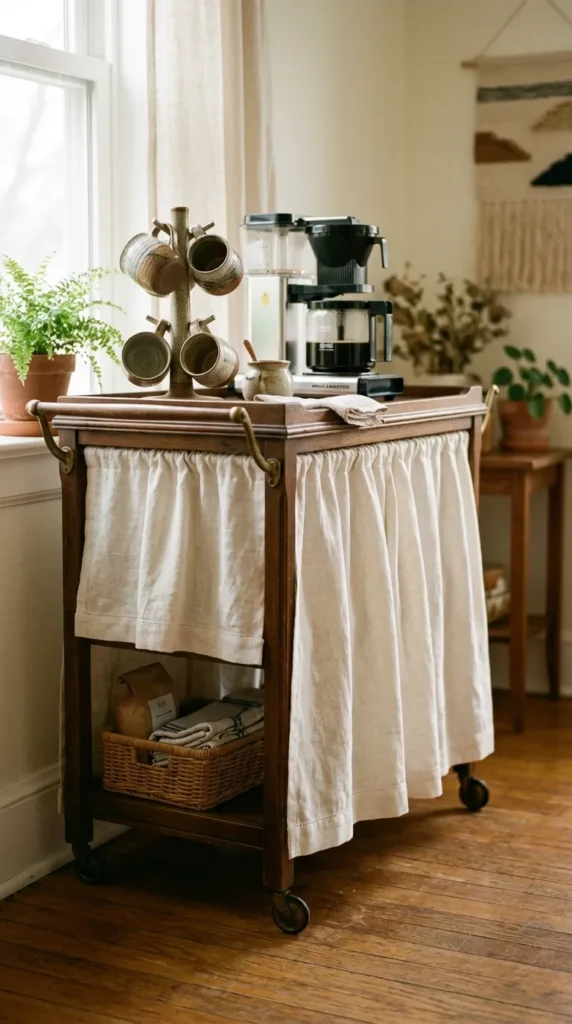
A bar cart is practical. But sometimes the lower shelf — with its coffee bags, French press, extension cord, and random pods — looks messy no matter how tidy you keep it.
A fabric skirt fixes this instantly.
Hang a hemmed linen curtain, a sink skirt, or even a section of cotton canvas from the front edge of the lower shelf. It hides everything underneath while making the cart look custom and finished.
You can find pre-made skirts online, or make your own with a yard of fabric and iron-on hem tape — total cost under $10. Attach it with small binder clips along the shelf edge, or use a thin curtain rod and brackets if the cart has a lower rail.
Linen, muslin, and cotton canvas all drape beautifully and look intentional. Avoid synthetic fabrics — they look cheap and do not hang as well.
This trick works on any cart style — industrial metal, wood, or vintage. The contrast between the clean skirt and the cart’s material adds texture to the space.
Beyond hiding clutter, the skirt softens the overall look of the cart. It takes a utilitarian piece of furniture and turns it into a designed object without spending more than a few dollars.
17. Upcycle a Sideboard Into a Coffee Station
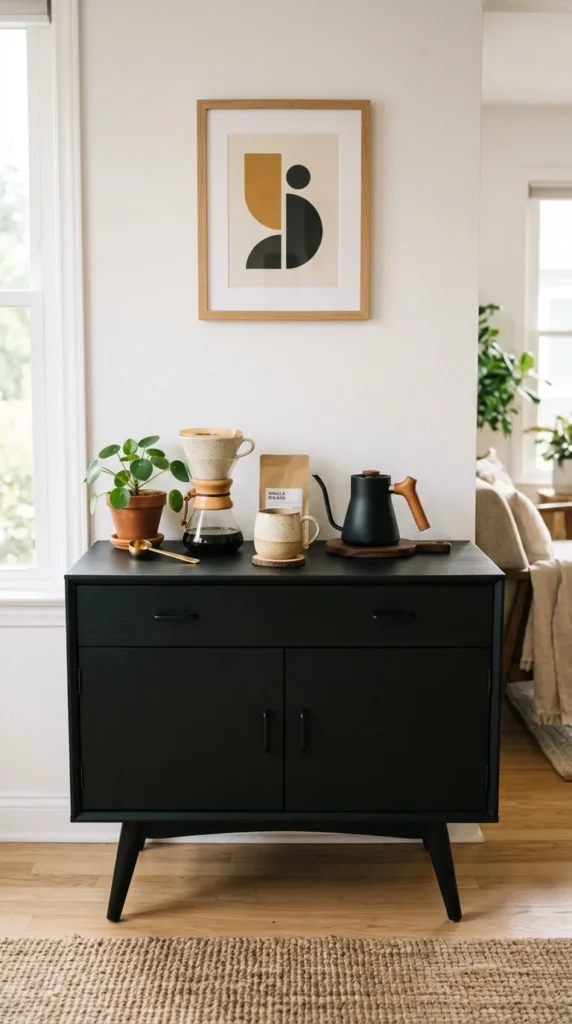
You do not need to buy anything new to build a great coffee bar. A secondhand sideboard or buffet cabinet is one of the best foundations for a home coffee station — especially in a small dining room or living area where there is no kitchen counter to spare.
Hit a thrift store, Facebook Marketplace, or your own garage. A solid wood sideboard in any condition works. Once you paint it, no one will know what it looked like before.
Spray paint is your best friend here. A can of matte black, sage green, or warm white spray paint transforms any piece for under $10. Lightly sand the surface, prime it, and apply two coats. Done.
Swap the hardware too. Matte black or brushed brass pulls cost around $3–$5 per knob and make a huge difference in how the piece looks.
Use the top surface for your machine and daily tools. Store everything else inside the cabinet: extra bags of beans, backup pods, syrups, and seasonal mugs.
This approach works especially well in open-concept homes or apartments where the coffee station lives in the dining area or living room rather than the kitchen. The sideboard looks like furniture, not an appliance station — which makes it feel right at home anywhere.
18. Use a Wooden Tray as Your Coffee Bar Foundation
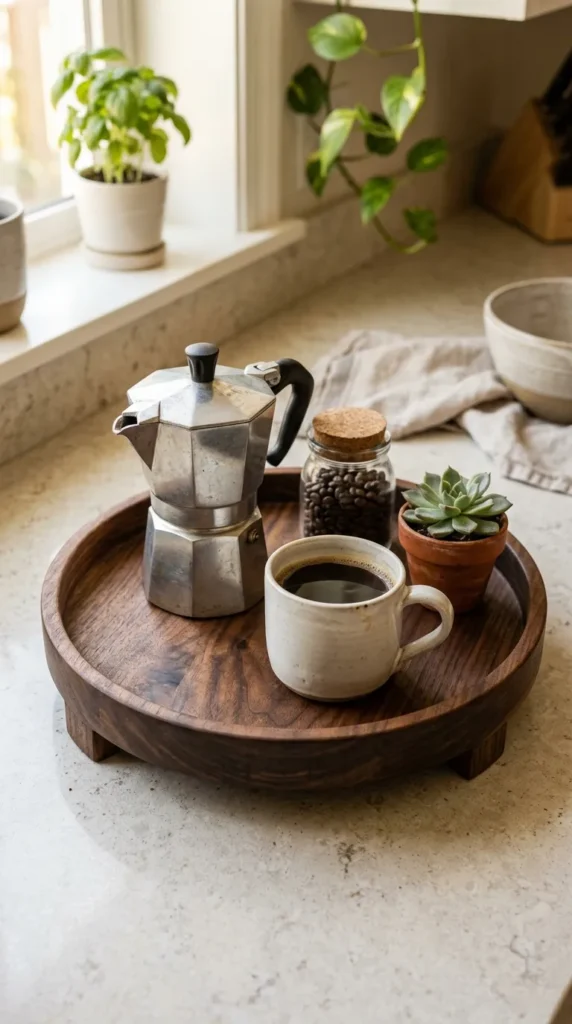
Sometimes the best small coffee bar idea is not a shelf, a cabinet, or a cart. It is a tray.
A footed wooden tray placed on your existing counter creates an instant coffee station without any installation. It corrals all your essentials into one contained zone, making the counter look organized even when it technically is not.
Choose a tray that is large enough for your machine plus two or three accessories — a mug, a small canister, maybe a plant. Twelve to sixteen inches across is usually ideal.
Inside the tray: machine on one side, mug tree or single mug on the other, small jar of beans in the middle. Keep it to four items max. The tray is doing the containing — let it do its job.
Footed wooden trays are available at TJ Maxx, HomeGoods, and Target for $15–$35. Dark walnut trays look especially good in modern and minimal kitchens. Lighter, painted trays work well in bright, farmhouse-style spaces.
This approach is also the easiest one to move. Hosting a dinner party and need the counter space? Slide the tray aside. Coffee ritual done.
One tray. Zero installation. Immediate impact. It is the most low-effort, high-reward idea on this list.
19. Set Up a Neutral-Toned Coffee Cabinet
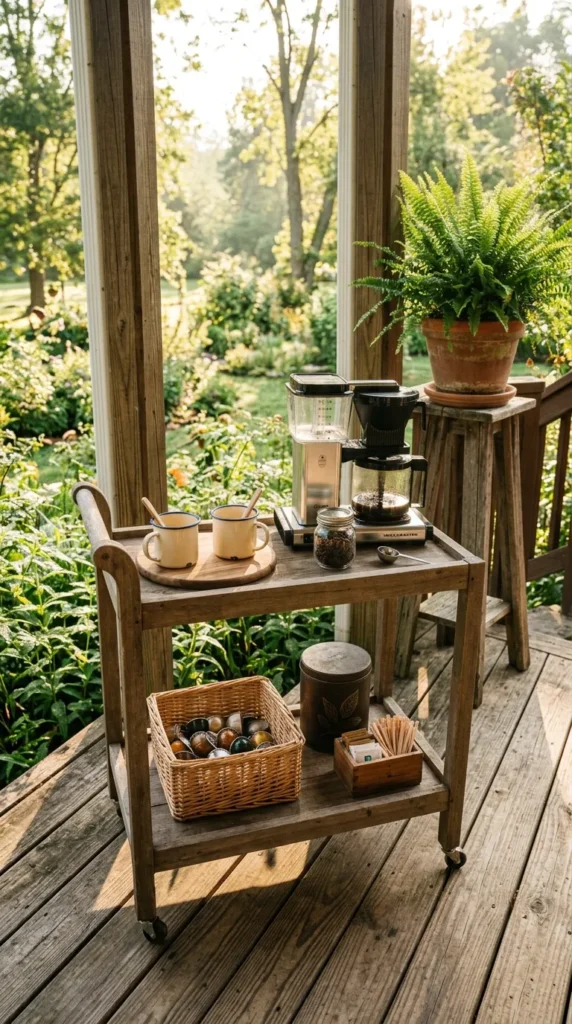
If you want your coffee station to look pulled-together without putting in much effort, stick to a two-color palette. Black and white is the most forgiving combination in home design.
Every accessory in a matching palette reads as intentional. A black machine next to a white mug next to a black canister next to a white plant pot — it looks designed even when you assembled it in fifteen minutes.
This principle works even in a small cabinet. Designate one cabinet for your coffee setup. Inside, keep only black and white items: mugs, the machine, canisters, a small tray.
Close the cabinet door and the rest of the kitchen stays clean. Open it and the inside looks like a little editorial moment.
Clear out any stray colored mugs or mismatched accessories. Donate them or move them somewhere else. Uniformity is what makes a two-color station look expensive rather than basic.
If black and white feels too stark, try a warm neutral palette instead — cream, natural wood, and matte tan. The same rule applies: commit to the palette and edit everything that does not belong.
This works at any budget. You do not need designer mugs or a high-end machine. You just need consistency. Same tone, same material, same visual weight. That is all a cohesive small coffee bar requires.
20. Take Your Coffee Station Outdoors on a Rolling Cart
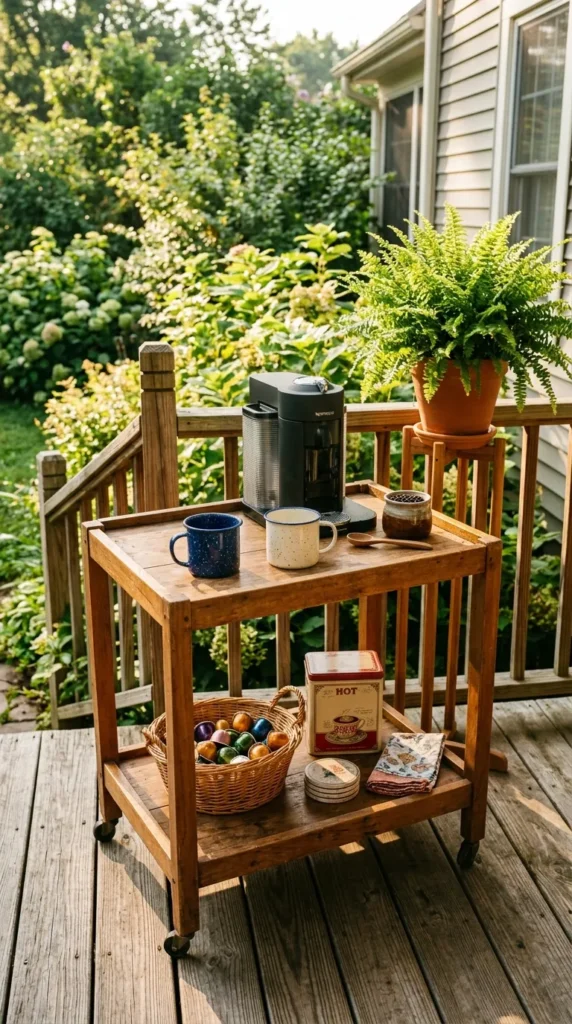
There is something about morning coffee outdoors that makes it taste better. If your porch, patio, or balcony gets good morning light, take your coffee station outside.
A rolling bar cart is the easiest way to do this. Load it up in the kitchen, wheel it out to the porch, lock the wheels, and brew in the fresh air. When you are done, wheel it back inside.
Outdoor coffee stations work best in spring and summer when the mornings are mild, but even in fall, a covered porch or pergola extends the season by weeks.
For warm-weather entertaining, add a hot chocolate station on the lower shelf alongside the coffee — chocolate powder, marshmallows, and a thermos of hot water. Guests serve themselves and you have spent almost nothing extra.
Keep the cart stocked with enamel or stoneware mugs rather than fine ceramics — they handle outdoor conditions better and feel more casual in the open air.
If you leave the cart outdoors for days at a time, invest in a waterproof cart cover. Many patio furniture brands sell universal covers for around $20.
This is the simplest outdoor coffee bar idea with the highest payoff. No building. No installation. Just wheels, a morning ritual, and a change of scenery.
21. Build a Bar-Height Ledge Along a Deck Railing
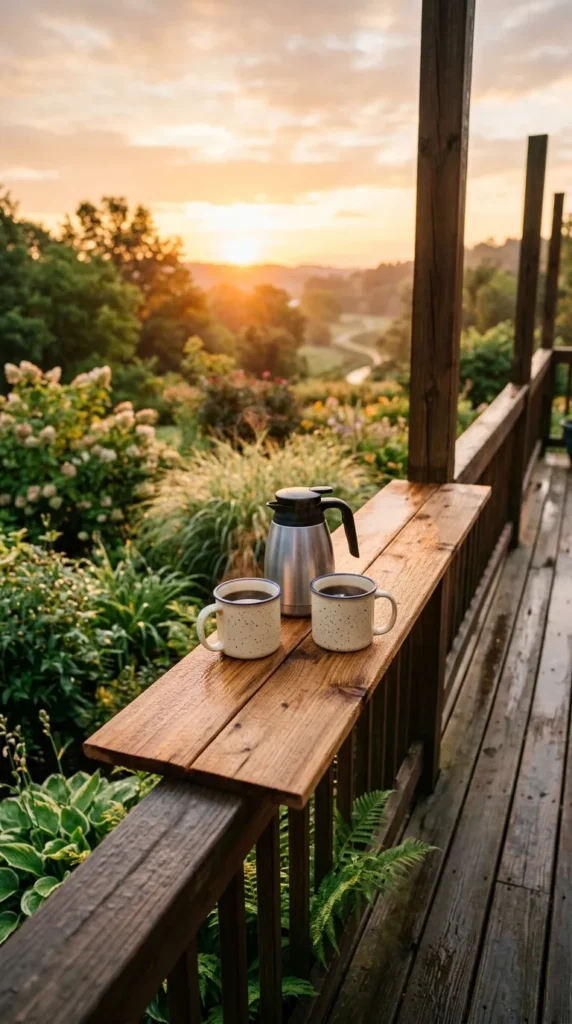
Most deck railings have a flat top cap — and that flat cap is already the right height for a stand-up coffee moment. Adding a slightly wider ledge turns it into a proper outdoor coffee bar with a view.
This is a weekend DIY project that costs almost nothing. Pick up a cedar or pressure-treated 2×6 plank, cut it to the length of your railing section, sand it smooth, and attach it with screws from below. Total material cost: around $20–$40.
Seal it with an exterior wood sealant to protect it from rain and sun. Teak oil also works beautifully on cedar and gives it a warm, rich tone.
On the ledge: two mugs, a small insulated carafe, and nothing else. The view is the decor. The ledge is just the platform.
This works especially well if your deck overlooks a garden, yard, trees, or open sky. Standing at a railing with a coffee in hand, looking out at the morning — that is the whole point of a coffee station outdoors.
The ledge can also hold a candle in the evening, a small herb pot, or your phone while you read. One simple addition. Many daily uses.
No cart required. No electricity required. Just wood, screws, and a morning habit.
22. Use Vertical Stacked Crates for a Balcony Station
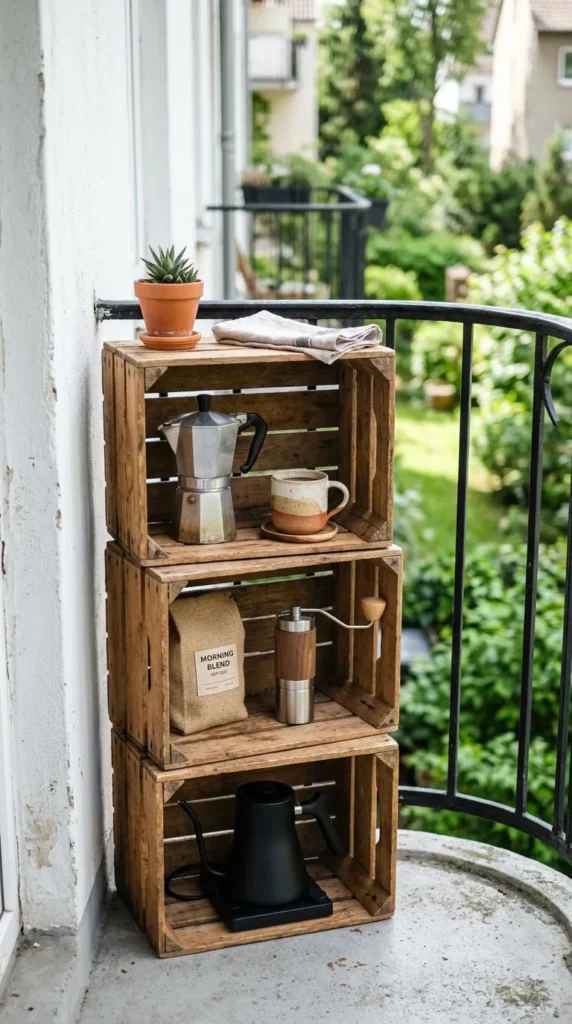
A balcony usually offers just enough room for one chair and a small table — if that. Stacked wooden crates are the vertical solution for getting a real coffee station onto even the tiniest balcony.
Stack two or three wine crates or produce crates against a wall or railing. They create shelves without taking up more floor space than a single crate footprint — usually about 12×20 inches.
Top crate: Moka pot or Aeropress, one mug. Middle crate: bag of beans, small hand grinder, sugar. Bottom crate: electric kettle or spare items.
You can find wooden crates at craft stores, thrift shops, and online for $5–$15 each. Sand rough edges, stain or paint them if you like, and secure them together with a couple of small L-brackets so the stack does not tip.
This setup needs no electricity if you use a Moka pot (for gas stoves indoors) or a pre-filled thermos of hot water. Brew inside, bring it out, and enjoy.
The whole station takes up about one square foot of floor space. For apartment balconies, this is the most space-efficient outdoor coffee bar option available — and one of the most charming.
23. Create a Coastal Coffee Bar With Weathered Wood
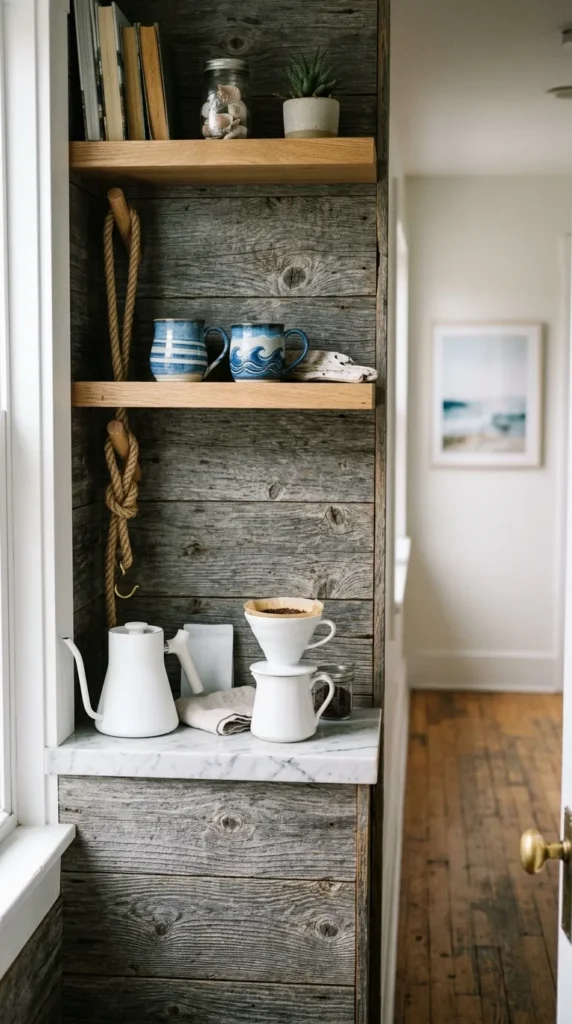
If your home has a coastal, beach house, or relaxed nautical feel, your coffee station should reflect that — not fight it.
Weathered wood paneling on the back wall of a niche or alcove sets the tone immediately. It adds texture, warmth, and a sense of age — which is exactly the quality that makes coastal spaces feel comfortable rather than sterile.
You can buy faux-weathered wood peel-and-stick planks online for about $30–$50 per box. They go up in an hour and do not damage the wall underneath — perfect for renters or anyone not ready to commit.
Pair the wood with a white or marble countertop for contrast. That light-and-dark combination — pale stone or tile against dark driftwood tones — is the visual shorthand for coastal style.
For accessories: white ceramics, a rope accent, blue mugs, or a small piece of actual driftwood. Keep the palette to two or three tones max: white, natural wood, and one accent color.
A waterfall counter edge — where the countertop material wraps down the side — adds a subtle detail that makes the station look more built-in and refined.
Designer Marnie Ousler, who built a version of this for a client, noted that a wall treatment behind the bar adds dimension — and that is the key insight here. The back wall does most of the design work.
24. Add a Chalkboard Sign Above the Station
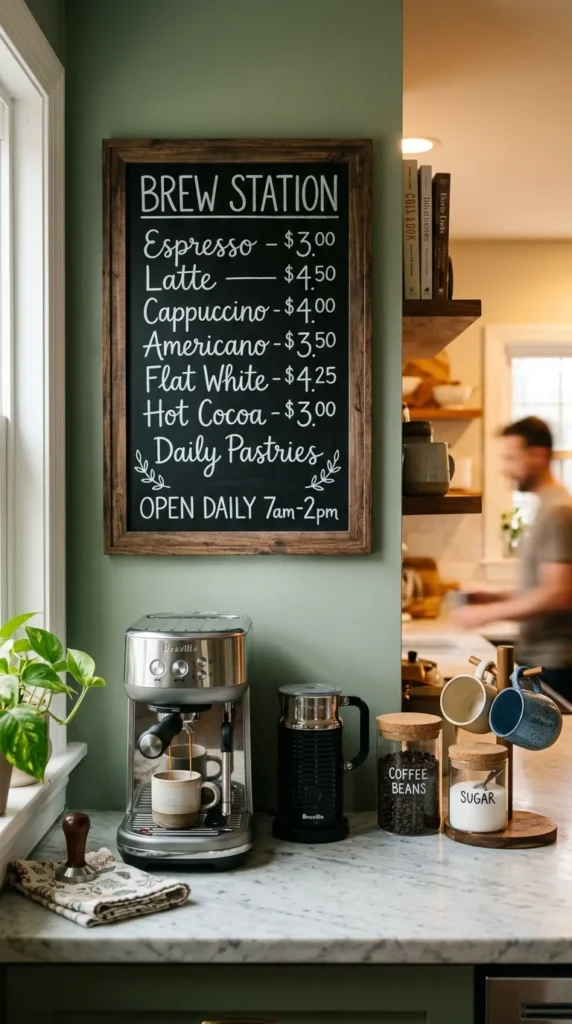
A chalkboard sign above a coffee station is one of those small touches that makes the whole setup feel like a real café — and it costs almost nothing.
Pick up a small framed chalkboard from Target, Amazon, or a craft store for $10–$20. Mount it on the wall above your machine. On it, write the drinks you typically make: espresso, pour-over, Moka pot, cold brew.
Change what’s written on it seasonally. In fall, write “pumpkin latte, chai, drip coffee.” In summer, write “cold brew, iced espresso, matcha.” It makes the station feel fresh each season without buying a single new item.
The chalkboard also functions as a reminder board for guests when you entertain. They can see at a glance what is available without asking.
Use a chalk marker (not regular chalk) for crisp lettering that does not smear with light touch. Wipe clean with a damp cloth.
Frame the chalkboard with a thin wood or metal frame to make it feel finished rather than like something from a classroom.
This is a $15 investment that dramatically changes the personality of a coffee station. It signals that the space was thought about — and that the person who uses it takes their morning ritual seriously.
25. Swap Décor Seasonally on a Mug Tree
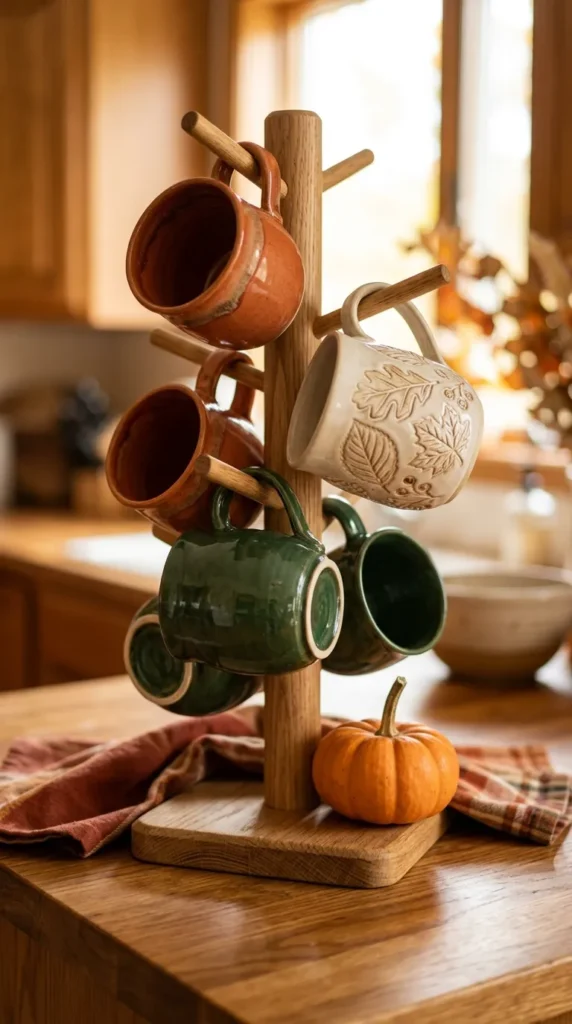
A mug tree is a $20–$40 investment that pays off every single day. It holds six to eight mugs upright on a central column with branch-like arms — and it keeps your most-used mugs accessible without opening a single cabinet.
But the real power of a mug tree is seasonal swapping.
Keep a small collection of mugs in different colors for different seasons. In spring and summer, use light, fresh tones: sage green, dusty blue, creamy white. In fall, pull out the terracotta, deep green, and warm amber mugs. In winter, go deep: navy, forest green, matte black.
Swap them every few months. Store the off-season mugs in a box or cabinet. This keeps the station feeling current without buying anything new.
A few framed prints, a small plant, or a seasonal object — a small pumpkin in October, a sprig of eucalyptus in January — next to the mug tree is all you need to make the station feel like it belongs to that moment in the year.
This is how you keep a coffee bar from feeling stale. Same equipment. Same location. New energy every season.
26. Use Matching Canisters for a Streamlined Look
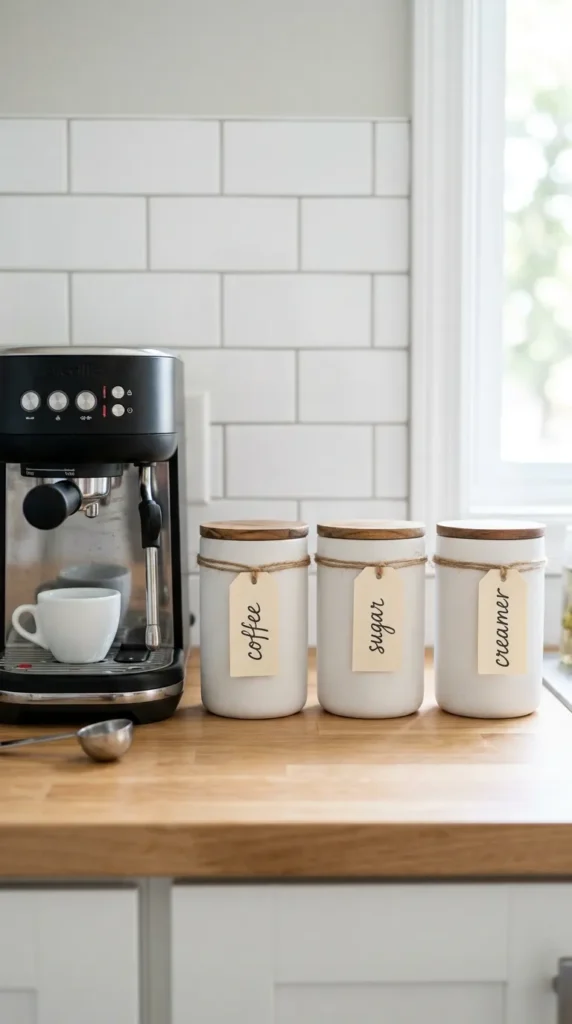
Random containers make any space look busy — even when everything is clean. Matching canisters are one of the cheapest ways to make a small coffee station look put-together.
Choose a set of three to four canisters in the same material and color. Ceramic in matte white or matte black is the most timeless choice. You can find sets of three at Target or HomeGoods for $20–$35.
Use them for: coffee beans, ground coffee, sugar, and coffee pods. Label each one with a small tag, chalk label, or printed sticker.
Line them up behind or beside your machine. Even spacing between them matters — put a finger-width of space between each canister so they do not look crammed together.
Canisters serve a practical function too: they keep beans fresh longer than leaving them in the bag, protect sugar from clumping, and make it easy to see at a glance when you are running low.
Avoid mixing materials. A ceramic canister next to a plastic canister next to a glass jar cancels out the visual order you are trying to create.
This is a $25 upgrade with an outsized impact on how organized and intentional your coffee station looks every day. Small, consistent, and completely worth it.
27. Add String Lights for an Outdoor Café Mood
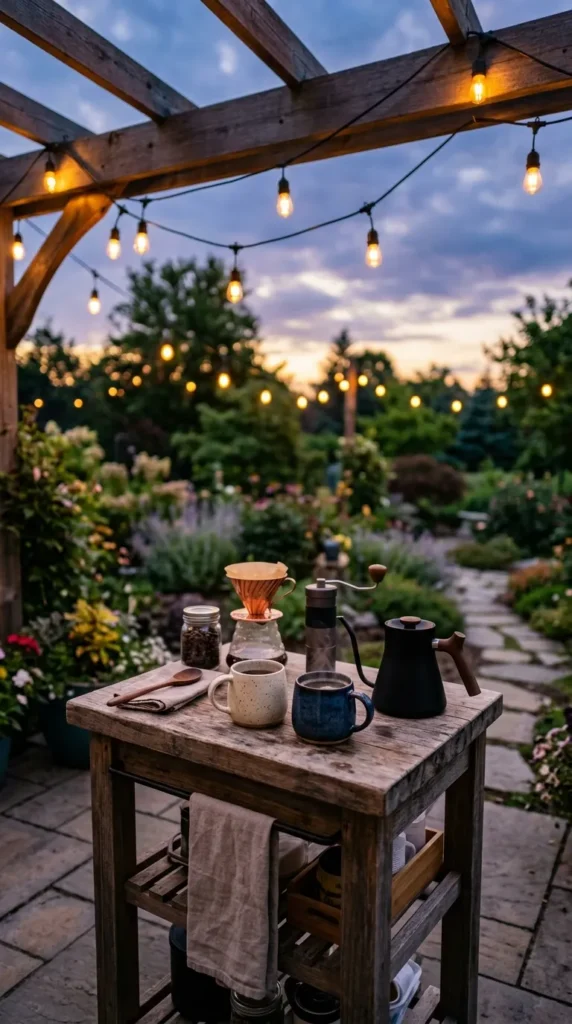
An outdoor coffee bar becomes something truly special when the lighting is right. And string lights — the Edison-style, warm-glow kind — are the fastest, cheapest way to transform a patio corner into a morning destination.
Hang them in a loose canopy above the coffee station using command hooks or a small tension wire between two posts. A 25-foot strand with 25 bulbs runs about $15–$25 on Amazon.
Warm white (2700K) is the tone you want — it mimics candlelight without being too dim. Avoid cool white or daylight bulbs outdoors; they feel harsh in the morning.
Plug the lights into an outdoor-rated timer so they turn on automatically before you wake up and off after morning. This small automation makes the routine feel effortless.
Pair the lights with a small outdoor candle or a pot of lavender beside the station for additional sensory richness.
The goal is to make the outdoor station feel like a destination — somewhere you walk toward on purpose, not just somewhere you brew because the weather is nice.
String lights are available everywhere and cost almost nothing. But they do more for the feel of an outdoor coffee station than almost any other single addition.
28. Style the Station With Potted Herbs Nearby
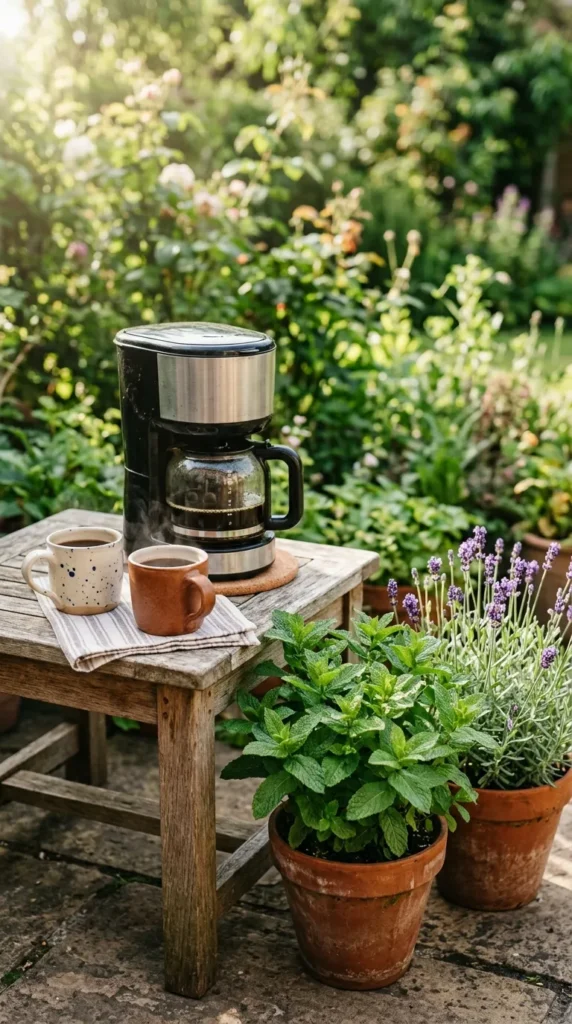
A coffee station should smell as good as it looks. Placing potted herbs near your coffee setup — indoors or outdoors — does exactly that.
Mint is the obvious choice. It smells incredible, grows quickly with minimal care, and works beautifully alongside a morning coffee ritual. Lavender is another strong option — its scent is calming and pairs well with the warm smell of fresh coffee.
For outdoor stations, keep a small terracotta pot of mint and one of lavender on the table or shelf beside your setup. Water them once every day or two and they will thrive through most of the warm season.
For indoor stations, a small potted herb on the shelf above the machine adds life and color to the setup. Rosemary in particular has a compact, architectural shape that works well in small spaces and does not need much light.
Herbs also serve a practical function: fresh mint in hot water is a free herbal tea when you want something different from coffee. Lavender can be steeped in warm water or added to a simple syrup for an easy lavender latte.
The visual effect of greenery beside a coffee station is immediate. It makes the space feel cared for and alive — which is the quality every good coffee bar should have.
29. Use a Foldable Bistro Table as a Balcony Coffee Bar
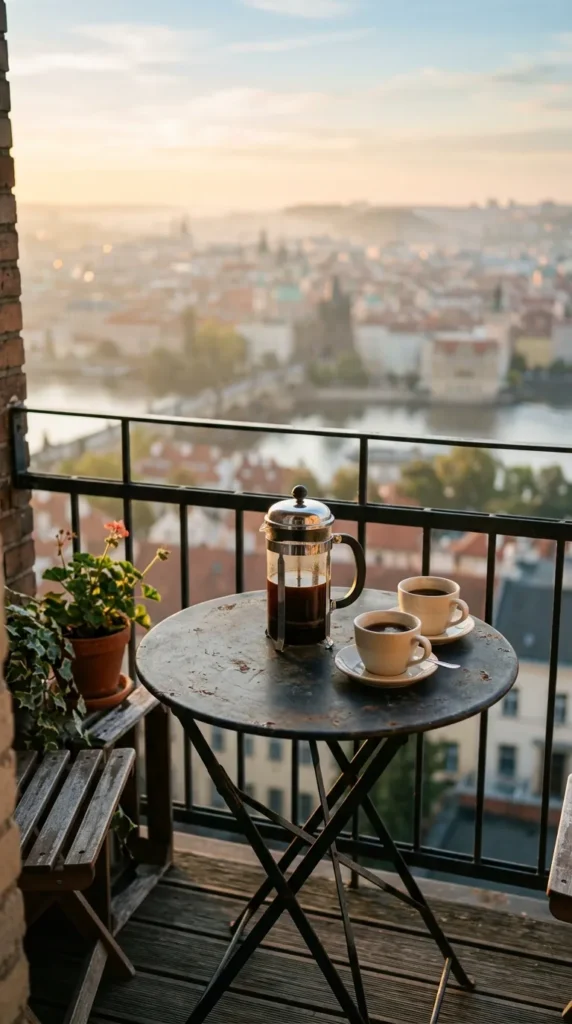
For balconies with almost no square footage, a small foldable bistro table is the most flexible outdoor coffee bar solution available.
A round bistro table — usually 24 inches in diameter — fits on even the narrowest balcony. Open it for your morning brew, fold it flat against the wall when you are done. Floor space: temporarily reclaimed.
Style it simply: a French press, two cups, and a small carafe of hot water. That is all you need for a complete outdoor coffee moment.
Bistro tables in metal or resin wicker are widely available at Target, IKEA, and outdoor furniture stores for $40–$80. Choose one with a powder-coated finish for weather resistance.
Add a single bistro chair or two — again, foldable — and the balcony becomes a destination rather than just a fire exit with a view.
On nice mornings, this setup beats any indoor coffee bar. The combination of fresh air, natural light, and a properly brewed cup of coffee is hard to replicate inside.
The fold-away nature of the setup also means it is easy to reconfigure the balcony for other uses: container gardening, exercise, or simply enjoying the open space without furniture in the way.
30. Designate Counter Space and Commit to It
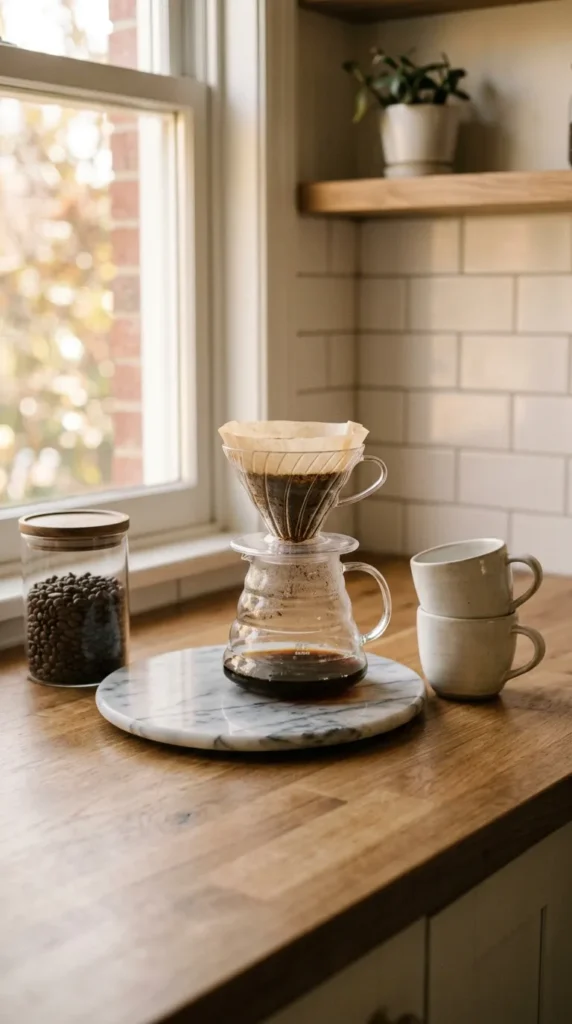
Sometimes the best coffee bar idea is not a new piece of furniture or a shelf or a cart. It is a decision.
Pick a section of your existing counter — even if it is just 18 inches wide — and commit it entirely to your coffee ritual. Remove everything else from that section. Keep only what belongs to your morning routine.
Machine on one side. Mug or mug tree on the other. One canister in between. That is your station.
This sounds simple because it is. But most people never do it because they are not willing to relocate the other things that have been living there. A fruit bowl, a pile of mail, a random appliance — these things drift onto counters without permission.
Push them somewhere else. Give the coffee station room to breathe.
Put a small round marble trivet or wooden board under the machine. This visually anchors the station and makes it look intentional rather than accidental.
The trivet also protects the countertop from heat and marks the boundary of the zone: everything inside the trivet is coffee. Everything outside it is something else.
You do not need to spend any money on this idea. You just need to decide — and then commit to keeping that space clear every day. Habits make coffee bars work. Design keeps them looking good.
Conclusion
Building a beautiful coffee bar in a small space is less about how much room you have and more about how intentionally you use what you have got. Whether you mount a peg rack for mugs, tuck a niche into your hallway, wheel a bar cart onto the porch, or simply dedicate one clean corner of your kitchen counter — every idea in this list works in a small space on a real-world budget.
Start with one idea. The one that fits your space today. Get it set up, use it for a week, and see how much it changes your mornings.
Small coffee bars work because they make the first part of your day feel considered. The machine is where you expect it. The mug is ready. The beans are in reach. That quiet readiness — that sense that your morning has a place of its own — is exactly what a good coffee station gives you.
No matter the size of your kitchen, your balcony, or your budget, your perfect coffee bar is closer than you think.